Transaction represents a group of activities that must be performed as a single work unit. This clarifies that a transaction is complete if and only if all the work items within a work group results in success. If any of the work items fails, then the transaction as a whole will be treated as a …
Java 7.0
Java 7.0 (Dolphin) Sun is releasing weekly early access snapshots of the complete source, binaries and documentation for JDK 7. These raw snapshot releases let you review and contribute to the Java SE platform as it is being developed. Some possible language changes being considered for Dolphin include: property support (for getFoo()/setFoo() pattern) method references …
Java 5.0
Java 5.0 Java Platform, Standard Edition (also known as Java 2 Platform) lets you develop and deploy Java applications on desktops and servers, as well as today’s demanding Embedded and Real-Time environments. Java SE includes classes that support the development of Java Web Services and provides the foundation for Java Platform, Enterprise Edition (Java EE). …
New Features in Java 7.0 – Part 1
This article discusses the new features that are available in Java 7.0. Java 7.0 comes with bunch of new features – language level changes as well as API level changes and this article concentrates on the new API features such as Cache API, New Date and Time API and New IO 2 as well as …
Ternary Operator in JSP 2.0 Expression Language(EL)
A very common need in a JSP page is to include a piece of template text only if a certain condition is true. With JSP 1.2 and JSTL 1.1, this is typically done using a block, but that’s a very verbose solution. also read: Java EE Tutorials Servlets Interview Questions New Features in Servlets 3.0 …
What is transient keyword in Java?
Java Transient Keyword This article explains about the transient variable and when it will be used in the Java programming. Another important fact is that, this question is most frequently asked in the Java interviews for checking the basic knowledge of a programmer. Another point is that the Java transient keyword is not frequently used …
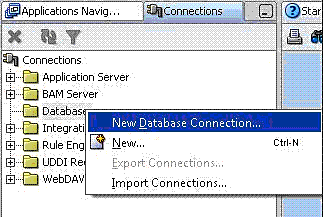
JDBC connection in JDeveloper with MySQL database
The Java Database Connectivity (JDBC) API is used to access a SQL database from a Java application. JDBC also supports tabular data sources, such as a spreadsheet. Oracle JDeveloper is a free Integrated Development Environment (IDE) for modeling, developing, debugging, optimizing, and deploying Java applications. JDeveloper 10g is used to develop J2EE applications comprising the JSPs, …
Benefits of using Web Services
Benefits of using Web Services Exposing the function on to network: A Web service is a unit of managed code that can be remotely invoked using HTTP, that is, it can be activated using HTTP requests. So, Web Services allows you to expose the functionality of your existing code over the network. Once it is …