When you are working with exception handling in Java, use of throw and throws may confuse you if you not familiar with the exception handling. Both are important keywords used frequently used in handling the exceptions. Throw is used for explicitly throwing an exception. Throw attribute in method signature, is a hint to the compiler …
Instance Initializer in Java
Instance initializer in Java is used for initializing the instance variables inside a class. It is a simple block without any modifiers used inside any class. If you declare a instance variable with value, then this value can be overridden in the instance initializer or in the constructor. The order of the execution as follows: …
Java EE Books
Head First Servlets And JSP by Bryan Basham, Kathy Sierra, Bert Bates This book will get you way up to speed on the technology you’ll know it so well, in fact, that you can pass the brand new J2EE 1.5 exam. If that’s what you want to do, that is. Maybe you don’t care about the …
Difference Between Class.forName() and ClassLoader.loadClass()
Class.forName() and ClassLoader.loadClass(), both the classes dynamically loading the classes to the classpath. However, there are subtle difference on initializing the classes at the time of loading and from where it is loaded. This tutorials compares both the form of class loading with simple examples. Class.forName() By default the classes are initialized at the time …

How To Generate Javadoc With Ant
This tutorial explains how to create Java documentation using the ant script. Every project has Java doc for the documentation purpose. If you have huge application, there should be a clear Java doc for the developers to aware of all the classes and its purposes. If the developers add good comments on their code, Java …

How To Change Tomcat Default Port Configuration?
Tomcat uses by default on port number 8080 on your computer. It is very common that you would have conflict of port number if there is another service running on the same port. You can change the port number for your tomcat server by changing in the configuration file or through the eclipse editor. 1. …
Struts 2 + JSON Integration
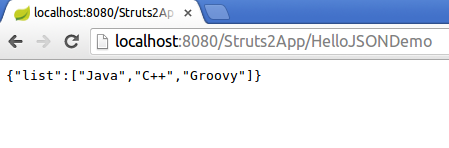
Struts 2 provides struts2-json-plugin.jar for supporting the conversion of result type to JSON strings. Nowadays every framework supports the JSON formats because it is the most preferred format for the REST web services. This example shows how you can integrate Struts 2 and JSON. Get the struts2-json-plugin.jar and add to the lib folder In the …
Struts 2 Resource Bundle Example
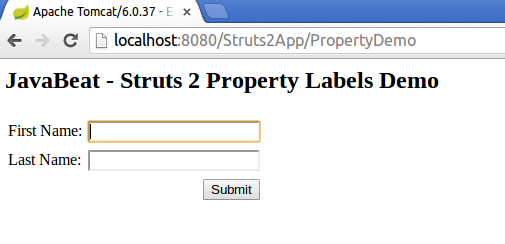
It is best practice to have all the labels used in your application in the centralized location. Tradionally these message resources are stored in the property files using the key=value pairs and loaded on demand by the forms. Every framework supports this basic feature to configure the message resources. This example shows how to load …